Solar IPS vs Regular IPS: Which One Fits Your Needs?
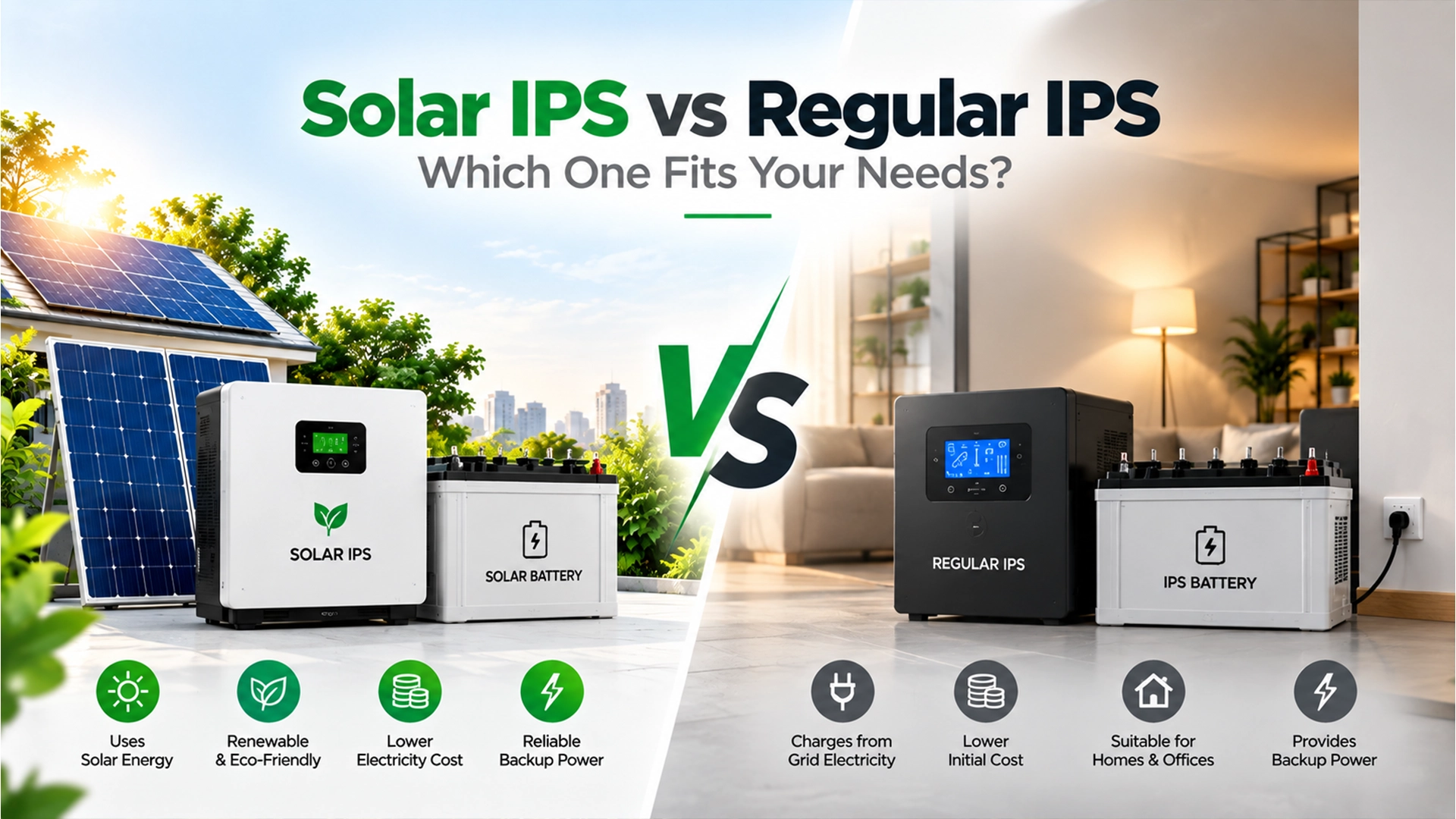
Power backup has become an important consideration for many homes, offices, shops, and businesses in Bangladesh. When choosing a backup solution, two common options are Solar IPS and Regular IPS. Although both can keep selected electrical devices running when grid electricity is unavailable, the way they receive, store, and manage energy can be quite different.
So, Solar IPS vs Regular IPS—which one should you choose? The answer depends on your electricity usage, backup requirements, access to sunlight, installation space, budget, and long-term energy goals.
This guide explains the major differences to help you understand which solution may better fit your needs.
What Is a Regular IPS?
A Regular IPS (Instant Power Supply) is a backup power system that normally charges its battery using electricity from the utility grid. When grid power is available, the IPS charges the connected battery. During a power interruption, stored battery energy is converted into usable AC electricity to power connected appliances.
A typical setup works like this:
Grid Electricity → IPS → Battery → Home/Office Appliances
Depending on its capacity, an IPS can support equipment such as lights, fans, routers, televisions, computers, and other suitable electrical loads.
Regular IPS systems are popular because they are relatively straightforward to install and do not require solar panels.
What Is a Solar IPS?
A Solar IPS combines backup-power functionality with the ability to use electricity generated by solar panels.
A typical solar IPS system may include solar panels, a solar-compatible inverter/IPS, batteries or another energy-storage system, protection equipment, wiring, and other system components.
Its basic energy flow can look like:
Solar Panels → Solar IPS/Inverter → Battery → Electrical Loads
Depending on the particular system, grid electricity may also be available as an additional charging or backup source.
This allows suitable users to utilize renewable solar energy while maintaining battery-backed power.
Solar IPS vs Regular IPS: Key Differences
Here is a simple comparison:
| Feature | Solar IPS | Regular IPS |
|---|---|---|
| Main Energy Source | Solar + grid depending on system | Grid electricity |
| Solar Panel Support | Yes | Usually no |
| Battery Backup | Yes | Yes |
| Initial Investment | Generally higher | Generally lower |
| Renewable Energy Use | Yes | No direct renewable generation |
| Installation | More components required | Relatively simple |
| Rooftop/Open Space | Usually required | Not required |
| Dependence on Grid Charging | Can be reduced | Generally dependent on grid |
| System Expansion | Possible with compatible design | Depends on IPS capacity |
| Best For | Renewable + backup solution | Straightforward backup |
1. Energy Source
The biggest difference between the two systems is where their stored energy comes from.
A regular IPS normally relies on grid electricity to charge its battery. This means the battery needs sufficient grid availability to recharge.
A solar IPS can use electricity generated by solar panels. Depending on its design, it may also use grid power when required.
For users who want to incorporate renewable energy into their power system, this is one of the biggest advantages of a solar IPS.
2. Initial Cost
A regular IPS generally has a lower initial investment because the system may require only the IPS, battery, cables, and related electrical components.
A solar IPS requires additional equipment such as:
- Solar panels
- Solar-compatible inverter/IPS
- Mounting structure
- Solar cables and protection
- Battery or energy storage
- Installation components
As a result, the upfront investment is typically higher.
However, comparing only the purchase price does not provide the complete picture. Buyers should also consider system lifespan, battery replacement, maintenance, electricity usage, expected solar generation, and long-term operating costs.
3. Electricity Cost and Solar Utilization
A regular IPS does not generate electricity. It stores electricity obtained from the grid and provides it when required.
A solar IPS can generate usable electricity from sunlight through connected solar panels. Depending on system design and consumption patterns, this may reduce the amount of grid electricity required for certain loads.
Actual savings are not the same for every installation. They depend on factors such as solar-panel capacity, available sunlight, electricity consumption, battery size, system efficiency, shading, installation quality, and how the system is configured.
Therefore, a proper load and site assessment should be completed before estimating financial benefits.
4. Backup Requirements
Both systems can provide backup power, but backup duration depends primarily on battery capacity and connected load.
For example, running a few LED lights, fans, and a Wi-Fi router requires much less energy than simultaneously operating several high-power appliances.
A common mistake is choosing an IPS based only on its advertised capacity without calculating actual load requirements.
Before buying, identify:
Total Load (Watts) + Required Backup Time + Battery Capacity + Inverter Capacity
This calculation helps determine the appropriate system.
5. Installation Space
A regular IPS usually requires comparatively little installation space. The IPS and battery can typically be installed in a suitable ventilated area.
A solar IPS additionally requires a suitable location for solar panels. Rooftops are commonly used, but panel placement should consider sunlight exposure, orientation, structural suitability, shading, and maintenance access.
If your property has significant shading or insufficient installation space, the practicality of solar should be assessed before purchase.
6. Environmental Considerations
Solar IPS systems can use renewable electricity generated from sunlight. During operation, solar photovoltaic panels generate electricity without direct combustion emissions.
For households and businesses looking to increase their use of sustainable energy in Bangladesh, solar can therefore form part of a broader clean-energy strategy.
Battery selection, responsible battery disposal or recycling, equipment lifespan, and overall system design should also be considered when evaluating environmental impact.
Which One Is Better for Your Home?
A Regular IPS may be suitable when your main objective is straightforward backup power, your initial budget is limited, or you do not have a suitable location for solar panels.
A Solar IPS may be worth considering when you have suitable rooftop or open space, want to utilize solar energy, and are prepared for a higher initial investment in exchange for a more renewable-focused energy system.
Neither option is automatically best for every household.
What About Offices and Businesses?
Commercial requirements can be significantly different from residential requirements.
An office may need backup for computers, networking equipment, lighting, security systems, and communication devices. A shop may prioritize lights, POS equipment, CCTV, and internet connectivity.
For larger businesses or industrial facilities, the system should be designed according to actual load profiles rather than simply choosing a standard residential IPS.
A professional assessment can determine whether the appropriate solution is a Regular IPS, Solar IPS, Hybrid Solar System, UPS, or a customized solar and energy-storage solution.
Solar IPS vs Regular IPS: Final Decision
The choice ultimately depends on what you want from your power system.
If your priority is simple backup power with a comparatively lower initial investment, a regular IPS can be a practical solution.
If your goal is to combine backup power with renewable solar energy and you have suitable installation conditions, a solar IPS may provide greater flexibility.
For Bangladesh, where solar energy can contribute to a more diversified and sustainable energy system, understanding these differences is increasingly valuable for both residential and commercial consumers.
Before purchasing either system, calculate your load, required backup time, available installation space, battery requirements, and budget. Proper system sizing is more important than simply choosing the biggest IPS or battery available.
Ecovilo — Powering a Cleaner, Greener & Brighter Bangladesh.